The Risk of Ruin in Trading Explained
Understand the risk of ruin in trading, how it is calculated, and how traders reduce the probability of losing their account.
The Risk of Ruin in Trading Explained: Mathematics Every Trader Must Know
The risk of ruin is the mathematical probability that a trader will lose their entire account or enough of it that recovery becomes impossible. This concept separates professional traders from gamblers. Ignoring it is the single biggest reason trading accounts are destroyed, emphasizing the critical role of risk management.
What Is Risk of Ruin in Trading?
Risk of ruin is the statistical probability that a trader will lose enough capital to prevent effective trading. This guide explains the concept, its calculation, and practical guidelines to keep your risk of ruin near zero. These principles apply universally and could save your trading career.
This guide explains the risk of ruin concept in plain language, shows you how it is calculated, and provides practical guidelines for ensuring your risk of ruin stays as close to zero as possible. Whether you are trading forex, stocks, futures, or crypto, these principles apply universally and could save your trading career.
Key Takeaway: Risk of ruin is determined by your win rate, average win/loss ratio, and risk per trade. By keeping risk per trade below 2% and maintaining a positive expectancy, traders can reduce their probability of account ruin to near zero.
🎸 Join RockstarTrader Free
RockstarTrader gives you 40+ professional trading tools in one platform — from journaling and performance analytics to risk calculators and market scanners. Everything you need to trade like a professional.
Get Started Free →Understanding the Concept of Risk of Ruin
Risk of ruin is the statistical probability that you will lose enough of your trading capital that you can no longer trade effectively. While the strict mathematical definition refers to losing 100% of your capital, most traders define ruin as a drawdown so severe that practical recovery is unrealistic — typically 40-50% or more. This threshold is crucial because recovering from a significant loss requires a disproportionately larger gain. For example, a 50% loss demands a 100% gain just to break even, which is a daunting task for even the most skilled traders.
The concept originated in gambling theory and was later adopted by financial mathematicians and professional traders. It provides a framework for understanding why certain trading approaches are mathematically doomed to fail, regardless of how good the underlying strategy might be. Ignoring risk of ruin is akin to building a house without a foundation; eventually, it will collapse, regardless of how beautiful the exterior appears.
Every trader has a risk of ruin, whether they calculate it or not. A trader risking 10% per trade with a 50% win rate has a dramatically higher risk of ruin than a trader risking 1% per trade with the same win rate. The difference is not marginal — it can be the difference between a near-certain blowup and a near-zero probability of ruin. This is why position sizing, which dictates the percentage of capital risked per trade, is often considered the holy grail of risk management.
The Mathematics Behind Risk of Ruin
The simplified risk of ruin formula for traders with a fixed percentage risk per trade is:
Risk of Ruin = ((1 - Edge) / (1 + Edge)) ^ Capital Units
Where: - Edge = (Win Rate × Average Win) - (Loss Rate × Average Loss) - Capital Units = Account Balance / Risk Per Trade
Let us work through a practical example to illustrate how this formula works:
- Win rate: 55% - Average win: $200 - Average loss: $150 - Account balance: $50,000 - Risk per trade: $500 (1% of account balance)
First, calculate the trading edge:
Edge = (0.55 × 200) - (0.45 × 150) = 110 - 67.5 = 42.5
Next, determine the number of capital units:
Capital Units = 50,000 / 500 = 100
Now, apply these values to the risk of ruin formula:
Risk of Ruin = ((1 - 42.5) / (1 + 42.5)) ^ 100 ≈ (( -41.5) / (43.5)) ^ 100
Wait, something is wrong here. The 'Edge' variable in the traditional risk of ruin formula represents the probability of a profitable outcome (p) versus an unprofitable outcome (q), often expressed as a relationship based on win rate and the ratio of average win to average loss. A more common formula for risk of ruin in trading, particularly when considering fixed-amount bets (or fixed-percentage risk resulting in 'capital units'), often relates to the probability of hitting zero before a predetermined profit target. For a simplified explanation adapted to percentage risking, the general concept of 'edge' (positive expectancy) and 'capital units' (number of times you can sustain a defined loss before ruin) is crucial. The formula provided is a variant of the gambler's ruin problem. A positive edge is fundamental. If the edge is negative, ruin is certain over time.
Let's refine the interpretation of "Edge" for this formula. In this context, "Edge" is often defined as the probability of a winning trade (Pwin) minus the probability of a losing trade (Ploss), adjusted for their sizes, or more simply for the formula provided, a positive value that indicates an expected return. A more common, simplified approximation for the probability of ruin involves only the win rate and the profit factor inherent in your strategy, which can be derived from average win and average loss. For educational purposes, let's assume 'Edge' here represents the overall positive expectancy factor of your strategy per unit risked, making the term (1 - Edge)/(1 + Edge) relevant for the probability of a negative swing. The higher the number of capital units, the lower the probability of ruin, assuming a positive edge. If the 'Edge' as calculated above means your expectancy per dollar risked, and it's positive, the risk of ruin for a high number of capital units (100 in this case) would indeed be very low.
With these parameters, assuming the edge correctly represents the probability factor for successive losses, the risk of ruin is effectively zero — well below 0.01%. This is why the combination of a positive edge and small position sizing is so powerful. It creates a robust system capable of withstanding inevitable losing streaks.
Now consider the same strategy but with 5% risk per trade ($2,500):
Capital Units = 50,000 / 2,500 = 20
The risk of ruin jumps dramatically. With only 20 capital units, even a modest losing streak can bring the trader dangerously close to ruin. A sequence of just 5-10 consecutive losses, which is entirely possible even for strategies with a 55% win rate, can decimate a significant portion of the account. This amplifies the psychological stress and often leads to emotional trading decisions, further accelerating losses.
The position size calculator on RockstarTrader helps you determine the exact risk per trade that keeps your risk of ruin at acceptable levels, aligning your trading actions with mathematical probabilities.
Factors That Influence Your Risk of Ruin
Several key variables determine your personal risk of ruin:
Win Rate
Higher win rates instinctively feel safer, and they do reduce risk of ruin, but only when combined with proper position sizing. A 70% win rate with 10% risk per trade can still lead to ruin because losing streaks — even for high win rate systems — are statistically inevitable. The law of large numbers dictates that even with a high win rate, a cluster of losses will occur over a sufficiently long series of trades. If your capital units are too few, such a cluster will be devastating.
Risk/Reward Ratio
The ratio between your average winning trade and average losing trade is critical. A trader with a 40% win rate but a 3:1 reward-to-risk ratio has a lower risk of ruin than a trader with a 60% win rate and a 0.5:1 ratio. This is because a higher reward-to-risk ratio means that winning trades contribute much more to your account than losing trades detract, providing a larger buffer against low win rates. Understanding risk-reward ratio is fundamental for building a resilient trading strategy.
Risk Per Trade
This is the single most controllable factor. Reducing risk per trade from 5% to 1% can reduce your risk of ruin from near-certain to near-zero, even with identical strategy performance. This inversely exponential relationship is why professional traders are obsessed with controlling risk per trade. It's the most direct and impactful way to manage the number of capital units you possess.
Account Size
Larger accounts have more capital units and thus lower risk of ruin, assuming constant dollar risk. This is one reason professional traders prefer percentage-based risk models — they scale naturally with account size. As your account grows, the absolute dollar amount you risk per trade also increases, but the *percentage* remains constant, thus increasing your capital units relative to your dollar-based stop loss.
Correlation Between Trades
If your trades are highly correlated — for example, you take multiple positions in the same sector during the same event, or even across different instruments that tend to move together (e.g., EUR/USD and GBP/USD) — your effective risk per trade is much higher than it appears. This hidden correlation increases risk of ruin by making what appear to be independent risks actually converge into a single, larger risk event. Diversification across uncorrelated assets or strategies is a key defense against this.
The Impact of Win Rate on Survival
Win rate has a non-linear relationship with risk of ruin. Small changes in win rate can have dramatic effects on long-term survival:
| Win Rate | Risk Per Trade | Approximate Risk of Ruin |
|---|---|---|
| 45% | 1% | High (>25%) |
| 50% | 1% | Moderate (~10%) |
| 55% | 1% | Low (<1%) |
| 60% | 1% | Very Low (<0.01%) |
| 50% | 5% | Very High (>50%) |
These numbers assume a 1:1 risk/reward ratio. With better risk/reward ratios, a lower win rate can still produce low risk of ruin. For example, a 35% win rate with a 2:1 risk/reward ratio can still be highly profitable and have a manageable risk of ruin if risk per trade is kept low. This demonstrates the powerful interplay between these metrics.
The critical insight is that even small edges become extremely powerful when combined with proper position sizing. A trader with just a 52% win rate and 1:1 risk/reward can have a near-zero risk of ruin if they risk only 1% per trade. This emphasizes that consistent, small gains, protected by stringent risk management, are the cornerstone of long-term success, far outweighing the allure of high-risk, high-reward gambles.
Track your actual win rate and risk metrics using a professional trading journal to understand your real-world risk of ruin. This data-driven approach is essential for accurate risk assessment and continuous improvement.
🎸 Start Your Trading Journal
Track and analyze every trade — identify patterns, fix mistakes, grow consistently.
Open Trading Journal →How Position Sizing Directly Controls Risk of Ruin
Position sizing is the most powerful lever available to control your risk of ruin. The relationship is exponential — small reductions in risk per trade produce massive reductions in ruin probability. This is due to the compounding effect of losses: a 10% loss requires an 11.1% gain to recover, but a 50% loss requires a 100% gain. By keeping individual losses small, you prevent the compounding of drawdowns from reaching critical levels.
Consider a strategy with a 50% win rate and 1.2:1 reward-to-risk ratio:
- At 10% risk per trade: Risk of ruin exceeds 80%. A few consecutive losses quickly lead to an unsalvageable account.
- At 5% risk per trade: Risk of ruin is approximately 40%. While better, this still presents a substantial chance of wiping out a significant portion of capital over time.
- At 2% risk per trade: Risk of ruin drops below 5%. This is a significant improvement, making professional trading viable.
- At 1% risk per trade: Risk of ruin approaches 0.1%. This level of risk provides an extremely high degree of safety, allowing a positive expectancy system to thrive over the long term.
- At 0.5% risk per trade: Risk of ruin is effectively zero. This ultra-conservative approach ensures maximum longevity, albeit with slower growth.
This illustrates why the 1% risk rule is so widely recommended by seasoned traders and financial experts. It provides a mathematical buffer that makes account ruin extremely unlikely for any strategy with a positive expectancy. It is not about maximizing immediate profits but about ensuring long-term survival and consistent compounding.
Professional traders calculate their position sizes before every trade using dedicated tools. The position size calculator automates this process and ensures consistency, removing emotional guesswork from a critical element of risk management. Using tools like this helps eliminate human error and reinforces disciplined trading habits.
Understanding Drawdown Probability
Even with proper risk management, drawdowns are inevitable. A drawdown is defined as a peak-to-trough decline in your account balance. Understanding the probability of various drawdown depths helps traders prepare psychologically and structurally, allowing them to remain calm and adhere to their strategy during difficult periods.
For a system with a 55% win rate and 1% risk per trade (assuming a 1:1 risk/reward ratio for simplicity):
- 5% drawdown: Will occur frequently (multiple times per year). These are common fluctuations and part of normal trading activity.
- 10% drawdown: Expected occasionally (1-3 times per year). While more significant, these are still within manageable parameters for a well-designed system.
- 15% drawdown: Rare but possible (once every 1-2 years). This level often triggers a review of the strategy or market conditions.
- 20%+ drawdown: Very rare but cannot be eliminated entirely, especially during extreme market conditions or extended periods of underperformance. This level typically requires a deep dive into the trading methodology and possibly a temporary reduction in risk or pause in trading.
Professional traders manage drawdown by implementing tiered response plans. Each drawdown level triggers specific actions — reducing size, reviewing strategy, or pausing trading entirely. This proactive approach prevents small drawdowns from spiraling into ruinous losses.
The key is accepting that drawdowns will happen while ensuring they remain within survivable limits through proper risk management. Use a drawdown calculator to model potential drawdowns for your specific strategy and risk parameters. Psychological resilience, combined with robust quantitative risk controls, is vital for navigating these inevitable periods.
Why Many Traders Ignore Risk of Ruin
Despite its importance, most retail traders never calculate their risk of ruin. Several psychological factors explain this:
Overconfidence bias: Traders overestimate their edge and believe losing streaks "won't happen to them." In reality, probability applies equally to everyone. This bias leads to taking on excessive risk, believing one's skill can overcome statistical reality.
Recency bias: After a winning streak, traders feel invincible and increase risk. This is precisely when risk of ruin increases, because the inflated confidence leads to larger positions right before an inevitable reversion to the mean or a losing streak. The market has a way of humbling overconfident participants.
Complexity avoidance: The math behind risk of ruin seems intimidating. Many traders avoid what they do not understand, preferring to focus on chart patterns and entries, which are often perceived as simpler or more exciting. This psychological hurdle prevents them from engaging with foundational principles.
Short-term focus: Calculating risk of ruin requires thinking about thousands of trades and long-term probabilities. Most retail traders think trade by trade, missing the statistical picture that determines their fate. They prioritize immediate gratification over sustainable growth.
Lack of tracking: Without proper performance tracking, traders do not know their actual win rate, average win, or average loss — making risk of ruin calculations impossible. A trading journal is therefore not just a suggestion, but a prerequisite for serious risk management.
Overcoming these biases requires self-awareness, discipline, and a commitment to a data-driven approach to trading. Acknowledging your psychological weaknesses is the first step towards implementing objective risk controls.
How to Minimize Your Risk of Ruin
Reducing your risk of ruin to near zero requires a systematic approach, integrating both theoretical understanding and practical application:
- Know your numbers — Track your win rate, average win, average loss, and expectancy over at least 100 trades. This statistically significant sample size provides reliable data for risk calculations.
- Risk 1% or less per trade — This single rule eliminates most ruin scenarios. For highly volatile markets or less liquid instruments, even 0.5% might be more appropriate.
- Maintain a positive expectancy — Your strategy must have a mathematical edge over time. Without it, even perfect risk management will only delay ruin.
- Set drawdown limits — Implement daily (2%), weekly (5%), and monthly (10%) loss limits. Adhere to these strictly, even if it means stepping away from the market for a period.
- Avoid correlated positions — Multiple positions in the same direction or highly correlated assets amplify your effective risk. Diversify your trades across different markets, sectors, or strategies.
- Review regularly — Use a trading journal to ensure your metrics haven't degraded and to adapt your risk parameters to changing market conditions. Quarterly reviews are a good starting point.
- Never increase risk after losses — Maintain fixed percentage risk regardless of recent results. Martingale-style strategies (doubling down after losses) are a fast track to ruin.
- Implement stop-losses on every trade — This is a non-negotiable rule. A stop-loss ensures your maximum potential loss per trade is always defined and controlled.
- Understand market volatility — Adjust your position sizing based on current market volatility. Higher volatility might warrant smaller position sizes to maintain the same dollar risk.
Monitor your risk metrics in real-time with RockstarTrader.com — built for traders who take risk management seriously. These tools provide the transparency and data necessary to make informed decisions.
Risk Models Used by Professional Traders
Professional trading firms and experienced individual traders employ sophisticated risk management models to safeguard capital and optimize returns:
Kelly Criterion: Calculates the optimal fraction of capital to risk based on edge and odds. While theoretically optimal for maximizing long-term wealth, it assumes precise knowledge of probabilities and outcomes, which is rarely fully available in trading. Most professionals use a fraction of the Kelly recommendation (half-Kelly or quarter-Kelly) for additional safety, recognizing that real-world trading involves uncertainty and strategy drift.
Value at Risk (VaR): Estimates the maximum expected loss over a given period (e.g., one day) at a specific confidence level (e.g., 99%). Used extensively by institutional traders to quantify portfolio risk, VaR provides a single number summarizing the downside risk of a portfolio. However, it has limitations, as it doesn't account for "tail risks" or extreme, rare events.
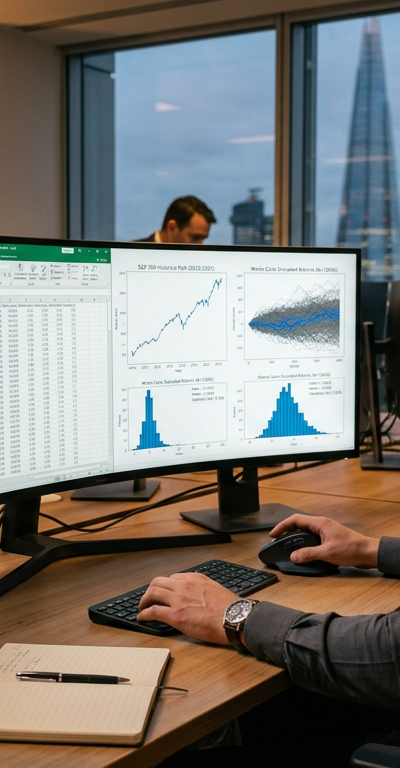
Monte Carlo Simulation: Runs thousands or even millions of simulated trading scenarios by randomly drawing from historical trade data or assumed probability distributions. This allows traders to estimate the distribution of possible outcomes, including worst-case drawdowns and probability of ruin, over various time horizons. It's a powerful tool for stress-testing a strategy under different market conditions and understanding the full spectrum of potential outcomes.
Fixed Fractional: Also known as percentage risk, this is the simplest model and involves risking a fixed percentage of current equity per trade. This model inherently adapts to account growth or shrinkage; as the account grows, the absolute dollar risk increases, and vice-versa. This is the most common approach for individual traders and is highly effective because it prevents over-risking during drawdowns and allows for exponential growth during winning streaks.
Regardless of the specific model used, the underlying principle is the same: understand the probability of adverse outcomes and size your positions accordingly. These models provide frameworks for objective decision-making, moving away from subjective biases and towards a quantitative approach to risk.
Practical Guidelines for Every Trader
Here are the actionable rules that keep your risk of ruin near zero, transforming theoretical concepts into daily trading habits:
- Never risk more than 2% of your account on any single trade. This is a foundational rule of professional risk management.
- Ideally, risk 0.5% to 1% for maximum protection. This lower risk per trade provides an even larger buffer against sequential losses.
- Ensure your strategy has a positive expectancy over a large sample of trades. If your strategy doesn't have an edge, no amount of risk management will save it.
- Track every trade in a trading journal to maintain accurate statistics on your win rate, average wins, and average losses. Garbage in, garbage out applies here.
- Implement daily loss limits and honor them without exception. These serve as emergency brakes to prevent spiraling losses on bad trading days.
- Review your risk of ruin quarterly as your metrics evolve and market conditions change. Your risk parameters should not be static.
- Use proper risk management calculators for every position. Tools like the position size calculator and risk/reward calculator are indispensable.
- Reduce position size during losing streaks — never increase it. This is counter to common psychological tendencies but essential for survival.
- Educate yourself continuously on risk management principles. The market is dynamic, and your understanding of risk should evolve with it.
- Practice patience and discipline. Trading is a marathon, not a sprint, and these virtues are vital for adhering to your risk plan.
Monitor your risk metrics in real-time with RockstarTrader.com — built for traders who take risk management seriously. These tools provide the transparency and data necessary to make informed decisions.
Frequently Asked Questions
What is a good risk of ruin percentage?
Professional traders aim for a risk of ruin below 1%. Ideally, it should be below 0.1%. This is achievable by risking 1% or less per trade while maintaining a strategy with positive expectancy and consistent performance over a statistically significant number of trades.
Can I calculate risk of ruin without complex math?
Yes. The simplest approach is to use the rule of thumb: if you risk 1% per trade with a strategy that wins more than it loses in expected value, your risk of ruin is effectively near zero. Online calculators and platforms like RockstarTrader can compute exact figures even with simplified inputs, making it accessible to all traders without deep mathematical expertise.
How many consecutive losses can I survive?
At 1% risk per trade, you can survive over 50 consecutive losses and still retain more than 60% of your capital. This illustrates the immense power of low-percentage risk. At 5% risk, however, just 13 consecutive losses would cut your account in half, demonstrating how quickly higher risk accelerates capital depletion.
Does risk of ruin apply to funded trading accounts?
Absolutely. Funded accounts have even stricter ruin thresholds since prop firm drawdown rules define maximum loss limits that, if breached, result in account termination. Understanding and actively managing your risk of ruin is therefore essential for passing and maintaining funded challenges, as these firms explicitly seek traders who can manage risk effectively.
How often should I recalculate my risk of ruin?
Review your trading statistics and risk of ruin at least quarterly, or whenever your strategy metrics change significantly. This includes shifts in your win rate, average win/loss, or market volatility. Consistent tracking in a trading journal makes this straightforward and ensures your risk parameters remain aligned with your current performance and market conditions.
Conclusion
The concept of risk of ruin is fundamental to long-term survival and success in trading. It highlights the mathematical probability of depleting your capital and underscores the critical importance of proper risk management, especially position sizing. By understanding your win rate, average win/loss ratio, and consistently applying a low risk per trade (ideally 1% or less), traders can dramatically reduce their risk of ruin to near zero. Ignoring these principles, on the other hand, makes account blow-ups almost inevitable, regardless of strategy performance. Professional tools and diligent tracking are essential for monitoring these vital metrics and safeguarding your trading career. Ultimately, managing the risk of ruin is not about avoiding losses entirely, but about ensuring that inevitable losses do not jeopardize your ability to continue trading and capitalize on your strategy's edge over the long run.
Related Resources
- Position Size Calculator: Accurately determine optimal position sizes based on your risk parameters to keep your risk of ruin in check and ensure you never over-leverage.
- Drawdown Calculator: Understand the likelihood and severity of potential drawdowns, which are closely related to your risk of ruin and psychological preparedness.
- Trading Journal: The essential tool for tracking all your trade data, calculating performance metrics, and systematically improving your trading strategy and risk management.
🎸 Join RockstarTrader Free
RockstarTrader gives you 40+ professional trading tools in one platform — from journaling and performance analytics to risk calculators and market scanners. Everything you need to trade like a professional.
Get Started Free →Ready to level up your trading?
Track, analyze, and improve your trades with RockstarTrader's trading journal.
Start Free Trial