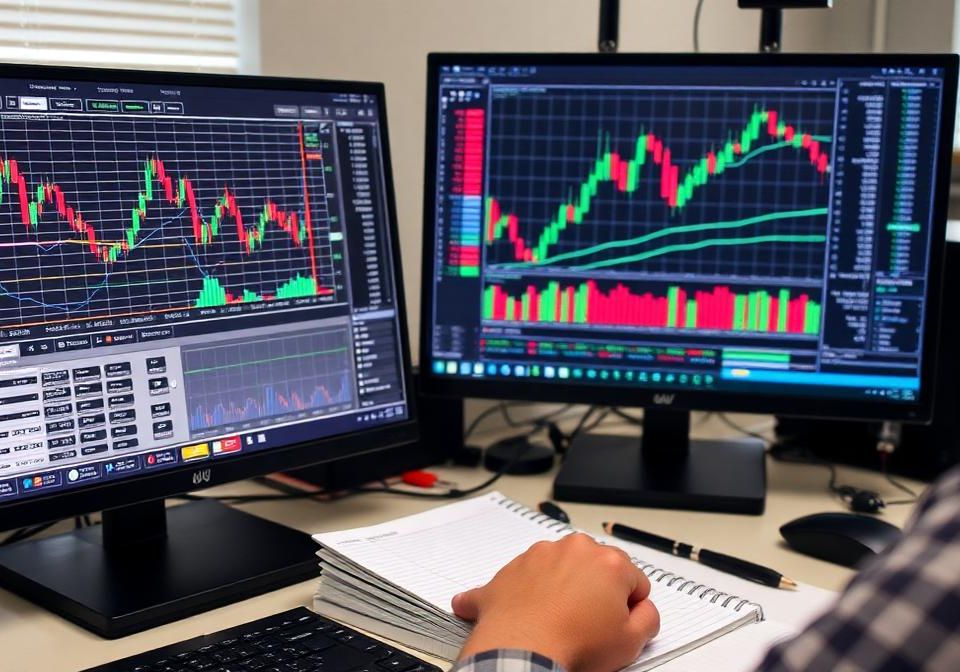
The Ultimate Trading Journal Template for Day Traders
Learn how to build a professional trading journal template for day trading. Track performance, analyze trades, and build the discipline that separates profitable traders from the rest.
Every profitable day trader has one thing in common: they track their trades. A trading journal template for day traders is the foundation of a structured trading workflow. Without a clear system for recording entries, exits, emotions, and outcomes, traders are left guessing what works and what doesn't. This guide walks through how to build a professional trading journal from scratch — and how the right template can transform your performance over time.
What Is a Trading Journal Template?
A trading journal template is a structured document or tool that traders use to log every trade they take. It records key details such as entry price, exit price, position size, risk/reward ratio, setup type, and personal notes. Traders use it to identify patterns in their performance, eliminate recurring mistakes, and refine their strategies over time.
The concept is simple, but the execution matters. A poorly structured journal creates busywork. A well-designed template turns raw trade data into actionable insights. Whether you use a spreadsheet or a professional trading journal, the structure of your template determines how much value you extract from it. For day traders, who make numerous trades in a short period, a streamlined and efficient template is crucial to avoid getting bogged down by administrative tasks and focus instead on high-impact insights.
🎸 Join RockstarTrader Free
RockstarTrader gives you 40+ professional trading tools in one platform — from journaling and performance analytics to risk calculators and market scanners. Everything you need to trade like a professional.
Get Started Free →Why Day Traders Need a Trading Journal
Day trading involves dozens of decisions every session. Without a journal, traders rely on memory — which is unreliable and biased. A trading journal solves this by creating an objective record of every decision. This objective record is vital for professional growth, as it moves traders away from emotionally driven decisions and towards data-backed strategies.
Here's why structured journaling matters:
- It reveals which setups produce consistent profits and which are costing you money. By analyzing historical performance, you can validate or invalidate your trading hypotheses.
- It exposes emotional patterns — revenge trading, FOMO entries, premature exits. Recognizing these patterns is the first step towards controlling them and improving trading psychology.
- It creates accountability. When you have to write down why you took a trade, you think twice before entering impulsively. This forces a disciplined approach and adherence to your trading plan.
- It tracks performance metrics like win rate, average R, and profit factor over time. These metrics are critical for understanding the probability and profitability of your strategy.
- It provides data for meaningful trade reviews — the process that separates amateurs from professionals. A thorough review leads to concrete adjustments and refinements of your trading edge.
Professional traders treat their journal the way athletes treat game film. It's the single most effective tool for improvement. For day traders, where the speed of execution and the volume of trades are high, a robust journaling system becomes an indispensable feedback loop.
Core Elements of a Professional Trading Journal Template
Not all journals are created equal. A professional trading journal template includes specific fields that go beyond basic trade logging. These fields provide the granular detail needed for in-depth analysis and strategy refinement. Here are the core elements every day trading journal should include:
Trade identification fields: These fields establish the foundational data for each trade.
- Date and time of entry/exit: Crucial for understanding performance across different market hours or days.
- Instrument or symbol traded: Helps identify which assets you trade most successfully.
- Direction (long or short): Essential for analyzing directional biases in your strategy.
- Position size and account allocation: Tracks how much capital you are deploying and helps manage risk according to percentages of your total trading performance.
Execution fields: These capture the mechanics of the trade, enabling analysis of entry/exit precision.
- Entry price and exit price: The exact prices at which you entered and exited the market.
- Stop loss and take profit levels: The predefined risk management points, helping to assess adherence to your trading plan.
- Commissions and fees: Often overlooked, but these can significantly impact daily profitability for high-frequency traders.
- Net P&L in both dollar terms and R-multiples: Profit and Loss in currency, alongside the normalized R-multiple (risk unit) which is key for strategy comparison.
Context fields: These provide qualitative insights into the trade environment and rationale.
- Setup type or strategy name: Categorizing trades by the strategy employed allows for performance comparison between different approaches.
- Market conditions (trending, ranging, volatile): Understanding the prevailing market environment when a trade was taken is critical for assessing strategy effectiveness.
- Session (London, New York, Asia): Different trading sessions exhibit unique characteristics; tracking this helps identify optimal trading times.
- Notes on trade rationale: A brief explanation of *why* you took the trade, linking it back to your trading plan. This is invaluable for review.
The best templates also include fields for tagging, emotional state, and post-trade analysis — which we'll cover in the next sections. These additional fields transform a mere log into a powerful self-diagnostic tool, enabling a deeper understanding of human factors in trading performance.
Many traders eventually move from spreadsheets to structured tools.
RockstarTrader's trading journal automatically tracks execution data, calculates metrics, and provides analytics — so you can focus on improving.
Access the Trading JournalWhat Trade Data Should Day Traders Track?
The data you track determines the quality of your analysis. Many beginners only log entries and exits, but professional traders go deeper. This granular data provides a comprehensive picture of each trade and its context, allowing for precise adjustments to your strategy. Here's what your trading journal template should capture for every trade:
- R-multiple: How much you risked versus how much you gained. A 2R trade means you made twice your risk. This is more useful than raw dollar amounts because it normalizes results across different position sizes, making performance comparable regardless of capital deployed. Using R-multiples helps you focus on strategy effectiveness rather than absolute dollar figures, which can vary wildly.
- Risk/reward ratio: The planned ratio before entry. Professional traders use a risk reward calculator to evaluate whether a trade is worth taking before they execute. This pre-trade assessment ensures that only trades with favorable potential returns relative to risk are considered.
- Hold time: How long you were in the trade. This reveals whether you're cutting winners short or holding losers too long. It can also identify if your strategy is suited for short-term scalping or slightly longer intra-day swings.
- Slippage: The difference between your planned entry and actual fill. Over hundreds of trades, slippage compounds significantly. Tracking this helps you understand execution efficiency and potentially adjust order types or brokers if slippage is consistently high.
- Position size: Whether you used proper sizing. A position size calculator helps ensure each trade stays within your risk parameters, preventing over-leveraging and protecting your capital. This is fundamental for managing overall portfolio risk.
- Entry and Exit Chart Snapshots: Including screenshots of the chart at your entry and exit points, marked with your reasoning, stop-loss and target, provides invaluable visual context for review. This allows you to re-live the trade setup and execution.
- Confluence Factors: List the technical or fundamental factors that aligned to create the trade opportunity (e.g., support/resistance, moving average cross, volume spike, news catalyst). This reinforces your understanding of your strategy's edge.
Tracking this data consistently is what turns a simple trade log into a genuine performance improvement system. Over time, you'll see exactly which variables correlate with your best and worst trades, enabling data-driven optimization of your trading strategy. This systematic approach is the hallmark of professional trading.
🎸 Start Your Trading Journal
Track and analyze every trade — identify patterns, fix mistakes, grow consistently.
Open Trading Journal →Psychological Notes and Emotional Tracking
One of the most overlooked aspects of a trading journal is emotional tracking. Markets don't just test your strategy — they test your psychology. A professional journal template includes space for recording your mental state before, during, and after each trade. This self-awareness is critical because emotional biases can often override even the most robust trading strategies.
Key psychological fields to include:
- Pre-trade confidence level: Rate your conviction from 1–5 before entering. Over time, you'll discover whether high-confidence trades actually perform better, or if overconfidence leads to sloppy execution.
- Emotional state: Were you calm, anxious, frustrated, or euphoric? Traders who track emotional patterns discover that their worst losses often cluster around specific emotional states. Recognizing these triggers is crucial for avoiding impulsive decisions.
- Trade execution quality: Did you follow your plan exactly, or did you deviate? Rate execution separately from the outcome. A perfectly executed losing trade offers valuable lessons, while a poorly executed winning trade might mask underlying problems.
- Post-trade reflection: What would you do differently? This is where the real learning happens. Engage in honest self-assessment, focusing on process improvements rather than just outcomes.
- External distractions: Note any events in your personal life or environment that might have influenced your focus or emotional state during the trading session. This helps identify optimal conditions for your trading.
- Physical state: Were you well-rested, hungry, or feeling unwell? Your physical well-being significantly impacts cognitive function and emotional control, both critical for day trading.
Many traders find that journaling their emotions is the single most impactful habit they develop. It shines a light on subconscious biases and provides actionable insights into how to cultivate a more resilient trading mindset. As explored in our guide on building trading discipline, consistency comes from self-awareness — and emotional tracking builds that awareness faster than anything else. Understanding your emotional landscape is as important as understanding market dynamics for long-term day trading success.
Setup Tagging and Trade Classification
Tagging is what transforms a journal from a historical record into an analytical tool. By classifying each trade with specific tags, you can filter and analyze subsets of your data to find patterns that would otherwise remain hidden. This is invaluable for optimizing your strategy, identifying your strengths, and eliminating weaknesses.
Common tags to implement in your template:
- Setup type: Breakout, pullback, reversal, range trade, gap fill, momentum, etc. This helps you determine which specific trade setups yield the highest profitability and win rates.
- Market condition: Trending, ranging, choppy, high-volatility, low-volatility. Understanding which market conditions your strategies perform best in allows you to adapt or sit out when conditions are unfavorable.
- Time of day: Market open, midday, close, overnight. Day trading often sees different liquidity and volatility profiles throughout the day; tagging by time helps identify your most profitable hours.
- Outcome quality: Full target hit, partial profit, break-even, stopped out, max loss. This allows for detailed analysis of trade management effectiveness, not just the final P&L.
- Mistake tag: Did you break any rules? Tag it for later review. Examples include "FOMO entry," "Revenge trade," "Lack of patience," "Missed exit." This is crucial for identifying behavioral errors.
- Instrument Class: Equities, Options, Futures, Forex. If you trade multiple asset classes, this tag helps pinpoint segment-specific performance. For day traders, identifying which instruments align best with your strategy is vital.
- Catalyst: Earnings, news event, technical break, sector rotation. Understanding the impetus behind a move can highlight opportunities or risks for future trades.
For example, after tagging 200 trades you might discover that your breakout setups during the New York open produce a 62% win rate with an average of 2.1R, while your midday range trades only win 38% of the time, often with negative R. That insight alone could reshape your entire approach, leading you to focus on your strengths and avoid less profitable trade types. This targeted analysis is a core benefit of a well-structured trading journal and is critical for optimizing your edge as a day trader.
The Daily and Weekly Review Process
Logging trades is only half the equation. The other half is reviewing them systematically. A trading journal template should support two levels of review, a short daily check-in and a more comprehensive weekly analysis, which together create a powerful iterative feedback loop that drives continuous improvement.
Daily review (5–10 minutes): This brief, end-of-day process helps consolidate lessons while the trades are fresh in your mind.
- Review every trade taken that day, noting its outcome and key data points.
- Note whether you followed your trading plan on each trade, highlighting deviations.
- Record your overall emotional state for the session, connecting it to overall performance.
- Identify one thing you did well and one thing to improve. This provides immediate, actionable feedback.
- Update your running P&L and R-multiple for the day.
Weekly review (30–60 minutes): This deeper dive into your trading data and psychology is where significant insights are uncovered and strategic adjustments are formulated. It's an opportunity to step back from the heat of battle and analyze the bigger picture.
- Calculate weekly metrics: total P&L, win rate, average R, profit factor, maximum drawdown. These provide a quantitative summary of your week. You can use a drawdown calculator to better understand risk exposure.
- Review your best and worst trades of the week, analyzing *why* they succeeded or failed. Look beyond just the outcome to the process.
- Look for patterns across setups, time of day, and market conditions using your tags. Are certain setups underperforming? Are you consistently losing money during specific hours?
- Analyze your emotional patterns over the week. Were there recurring emotional states tied to specific outcomes?
- Adjust your trading plan based on what the data shows, making concrete, testable changes for the upcoming week. This might involve refining entry criteria, adjusting position sizing, or avoiding certain market conditions.
- Set specific goals for improving your trading process in the next week.
The weekly review is where breakthrough insights happen. As covered in our article on essential trading metrics, understanding your numbers over a meaningful sample size is what separates consistently profitable traders from everyone else. This structured review process is the bedrock of continuous improvement for any serious day trader.
Common Trading Journal Mistakes
Even traders who commit to journaling often make mistakes that limit the value they get from the process. Recognizing and avoiding these common pitfalls can significantly enhance the effectiveness of your trading journal and accelerate your learning curve.
- Only logging winners: Cherry-picking profitable trades defeats the purpose. Your losing trades contain the most valuable lessons, revealing flaws in your strategy or execution. Every trade, regardless of outcome, offers an opportunity for learning.
- Logging without reviewing: Many traders diligently record every trade but never go back to analyze the data. Without review, the journal is just a list of past events; it's the analysis that transforms data into actionable insights.
- Overcomplicating the template: If your journal requires 15 minutes per trade, you'll stop using it within a week. Start simple and add fields gradually as you identify specific data points that contribute most to your analysis. Prioritize clarity and ease of use.
- Ignoring emotional data: Skipping the psychological notes removes one of the most powerful dimensions of trade analysis. Emotional control is paramount in day trading, and understanding your emotional triggers is a massive edge.
- No consistency: Journaling for a week, then stopping for a month, then starting again produces fragmented data that's almost impossible to analyze meaningfully. Consistency is key; even brief, daily entries are better than intermittent, detailed ones.
- Focusing solely on P&L: While profit is the goal, focusing only on the dollar outcome without analyzing the process obscures the real drivers of success or failure. Measure process adherence and R-multiples for a more accurate picture.
- Lack of visual aids: Not including chart screenshots with entries, exits, stop losses, and targets marked down hinders effective visual recall and analysis of trade setups and execution.
The key is to find a workflow that's sustainable. Your journal should take no more than 2–3 minutes per trade to fill out, and your daily review should be a quick 5–10 minute routine at the end of each session. Adhering to this balanced approach ensures that journaling remains a beneficial habit rather than a burdensome chore, providing continuous feedback critical for long-term improvement as a day trader.
Spreadsheet Trading Journals vs Professional Journal Software
Many traders start with a spreadsheet — and that's perfectly fine for getting started. A Google Sheets or Excel template gives you full control over the layout and fields. However, spreadsheets have significant limitations as your trading volume grows, especially for day traders who make numerous entries.
Spreadsheet advantages:
- Free and fully customizable: You can design it exactly to your preferences without cost.
- Good for learning what fields matter to you: The process of building one helps you define your needs.
- No account or subscription required: Accessible to everyone with basic office software.
- Offline access: Can be used without an internet connection if stored locally.
Spreadsheet limitations:
- Manual data entry is time-consuming and error-prone: Copying and pasting data for dozens of daily trades can lead to mistakes and take valuable time away from analysis or trading.
- No built-in analytics or visualizations: Requires manual creation of charts, pivot tables, and statistical analysis. This can be complex and time-consuming.
- Difficult to filter, tag, and analyze at scale: As your trade history grows, complex filtering and cross-analysis become cumbersome.
- No automated performance calculations: All metrics (win rate, profit factor, R-multiple, drawdown) must be calculated using formulas, which can be prone to error.
- Lacks qualitative features: Integrating chart screenshots, video recordings, or elaborate psychological notes can be difficult and clunky.
Professional journal software advantages:
- Automated trade imports from brokers: Saves immense time and eliminates data entry errors by syncing directly with your trading platform.
- Built-in analytics, charts, and performance dashboards: Provides instant, visual insights into your trading performance, metrics, and trends without manual effort.
- Tagging, filtering, and pattern recognition: Advanced features allow for effortless segmentation and analysis of trades by any criteria you define.
- Integrated risk management tools: Many platforms offer tools to help you manage risk, calculate position sizes, and track capital allocation.
- Cloud-based access from any device: Allows you to log and review trades from anywhere, ensuring continuity in your journaling process.
- Support for qualitative data: Often allows for easy attachment of chart screenshots, video links, and extensive text notes.
Most traders who stick with journaling long-term eventually migrate to dedicated software. The time saved on data entry and the depth of analysis available make it a worthwhile investment — as we explored in our blog post comparing trading journal software. For a day trader where time is literally money, the efficiency and analytical power of professional software can be a game-changer.
Implementing a Structured Trading Journal Workflow
The best trading journal template is one that fits seamlessly into your daily routine. A structured workflow ensures that journaling becomes a consistent habit rather than an occasional chore. This consistency is paramount for generating reliable data for analysis and continuous improvement. Here's a practical workflow that professional traders use:
Before the session: (5-10 minutes) This preparatory phase sets the stage for disciplined trading.
- Review your trading plan and key levels for the day. This reinforces your strategy and identifies potential trade zones.
- Note your emotional state and energy level. Acknowledge your mental readiness to trade.
- Set maximum loss limits for the session and for any individual trade. Use a position size calculator to ensure your risk is aligned with your account size and risk tolerance.
- Briefly review your goals for the day, which might include specific setups to look for or behaviors to improve upon from your previous review.
During the session: (1-2 minutes per trade) Keep this part concise and focused on capturing essential real-time information.
- Log trades as you take them — don't wait until the end of the day. For day traders, memories fade quickly. Capture entry, stop, target, risk/reward ratio, and initial thoughts immediately.
- Note your rationale for each entry in real time. This reinforces your decision-making process and helps you critique it later.
- Tag each trade with setup type and market conditions. This instant classification saves time during review.
- Briefly note your psychological state at entry and any significant emotional shifts during the trade.
After the session: (5-10 minutes) This post-session review consolidates learning and prepares you for the next trading day.
- Complete your daily review, filling in exit details, P&L, R-multiple, and slippage.
- Rate your overall execution quality for each trade and the session as a whole.
- Identify the one key takeaway from the session — a lesson learned, a pattern observed, or a behavior to reinforce/correct.
- Plan any necessary adjustments to your watchlist or next day's strategy based on market action.
This workflow takes 15–20 minutes total per trading day and produces a comprehensive dataset that compounds in value over weeks and months. The traders who commit to this process consistently outperform those who trade without structure. It transforms trading from a speculative activity into a quantifiable, improvable skill, akin to a scientific experiment where each trade is a data point in your personalized quest for an edge.
Frequently Asked Questions
What should a trading journal include?
A complete trading journal should include the date, instrument, direction, entry and exit prices, position size, stop loss, take profit, net P&L, R-multiple, setup type, market conditions, emotional state, and post-trade notes. For deeper analysis, consider adding chart screenshots, slippage, hold time, and specific confluence factors that led you to take the trade. The more context you record, the more useful your analysis becomes during weekly reviews.
Do professional traders use trading journals?
Yes. Nearly all consistently profitable traders use some form of trade journal. At institutional trading firms, trade logging and post-trade analysis are mandatory processes, ensuring accountability and continuous learning. Independent professional traders who journal regularly report better discipline, fewer emotional trades, and more consistent performance compared to those who don't. It's a fundamental tool for performance optimization.
Is a spreadsheet trading journal enough?
A spreadsheet works well for beginners or traders with low volume. It's free, customizable, and a good way to start understanding what data is most relevant to your trading. However, as trade count grows, spreadsheets become time-consuming for manual data entry and limited in analytical capability. Professional trading journal software offers automated imports, built-in analytics, and tagging features that make review significantly more efficient and insightful, ultimately saving time and enhancing learning for active traders.
How often should traders review their journal?
Daily reviews should take 5–10 minutes after each trading session to log trades and note observations, keeping the experience fresh. A deeper weekly review of 30–60 minutes should analyze patterns, calculate performance metrics, and identify areas for improvement across a broader sample of trades. Monthly reviews are valuable for assessing longer-term strategy performance, identifying macro trends in your trading, and making structural adjustments to your overall trading plan or risk management approach.
What is the best trading journal software?
The best trading journal software depends on your specific needs, but key features to look for include automated trade imports, robust tagging and filtering capabilities, comprehensive performance analytics with customizable dashboards, integration with risk management tools, and cloud access for flexibility. Platforms like RockstarTrader combine journaling with calculators, market scanners, and analytics in a single integrated workspace, offering a holistic solution. Consider factors like ease of use, supported brokers, pricing, and community features when making your choice.
Conclusion
A trading journal template for day traders is not optional — it's essential for anyone serious about long-term profitability. Every trade you take is a data point, and the traders who collect, organize, and analyze that data are the ones who improve consistently. This systematic approach allows you to identify your edge, understand your weaknesses, and refine your strategies based on objective evidence rather than subjective feelings. Whether you start with a simple spreadsheet or a professional platform, the habit of structured trade tracking is what separates disciplined traders from gamblers.
Start simple. Be consistent. Review your data daily and weekly. Over time, your journal will become the most valuable tool in your trading arsenal — because it shows you exactly who you are as a trader, what works for you, and exactly where you need to improve. Embrace the feedback loop, dedicate time to self-analysis, and watch your trading performance transform.
🎸 Join RockstarTrader Free
RockstarTrader gives you 40+ professional trading tools in one platform — from journaling and performance analytics to risk calculators and market scanners. Everything you need to trade like a professional.
Get Started Free →Related Resources
- Position Size Calculator
- Risk/Reward Calculator
- RockstarTrader Trading Journal
- Essential Trading Tools for Every Trader
- Best Trading Journal Software Compared
Ready to level up your trading?
Track, analyze, and improve your trades with RockstarTrader's trading journal.
Start Free Trial