What Is Trade Distribution
Trade distribution refers to the specific sequence and pattern of winning and losing trades within a strategy's total performance sample.
Understanding the statistical nature of the markets is what separates professional traders from hobbyists. While beginners often focus solely on the outcome of a single trade, experienced market participants view their performance through the lens of a larger sample size. This perspective is centered on the concept of trade distribution. Trade distribution describes how your winning and losing trades are dispersed over time. It is a critical component of risk management and psychological fortitude, as it helps traders understand that even a high-probability strategy can experience strings of losses or periods of underperformance. By mastering this concept, you can move away from emotional decision-making and toward a data-driven approach that prioritizes long-term sustainability over short-term gratification.
What Is Trade Distribution in Trading?
Trade distribution is the chronological sequence and statistical variance of wins and losses over a specific sample of trades. It illustrates that outcomes do not occur in a perfectly alternating order but often appear in clusters. Understanding this distribution helps traders manage drawdown expectations, refine risk management, and maintain psychological discipline during losing streaks.
Access 40+ Professional Trading Tools — No Credit Card Required
The Importance of Statistical Thinking
To grasp trade distribution, one must first embrace statistical thinking. In the world of retail trading, many individuals treat every trade as a singular event that must result in a profit. This mindset is fundamentally flawed because it ignores the inherent randomness of the market. Even the most refined trading edge is subject to the law of large numbers. This law states that as a sample size grows, the actual results will converge toward the expected mathematical outcome.
When you analyze your results, you are not just looking at a total profit and loss figure. You are looking at a distribution. If you have a strategy with a positive expectancy, you know that over 100 trades, you will likely be profitable. However, the distribution within those 100 trades is unknown. You might start with ten consecutive losses (a drawdown) or ten consecutive wins (a "hot" streak). Understanding that these clusters are a natural part of the distribution prevents you from changing your strategy prematurely during a losing streak or becoming overconfident during a winning streak.
Furthermore, statistical thinking allows you to detach your self-worth from individual trade outcomes. If you view a loss not as a failure, but as a necessary data point within your trade distribution, you maintain the psychological equilibrium required to execute the next trade without hesitation. This is the cornerstone of professional-grade trading.
To achieve this level of clarity, many professionals use a Trading Journal to visualize their data. Without a centralized log, your mind will likely remember the most recent trades more vividly than the overall distribution, leading to "recency bias." By reviewing a journal, you ground your decisions in long-term facts rather than short-term feelings.
Normal vs. Skewed Distributions in Trading
In classical statistics, a normal distribution (or bell curve) suggests that most data points cluster around the mean. However, in trading, distributions are rarely symmetrical. Most successful trading strategies rely on a specific type of skew to remain profitable over the long term. This is why understanding the shape of your trade distribution is vital for portfolio management.
A trend-following strategy, for example, typically exhibits a "long-tail" distribution. This means the trader experiences many small losses and a few exceptionally large winners that compensate for those losses. The win rate might be as low as 30% or 40%, but the positive skew ensures profitability. Conversely, a mean-reversion strategy might have a very high win rate with many small winners, but it carries the risk of a "fat tail" on the loss side—where a single outlier loss could wipe out weeks of gains.
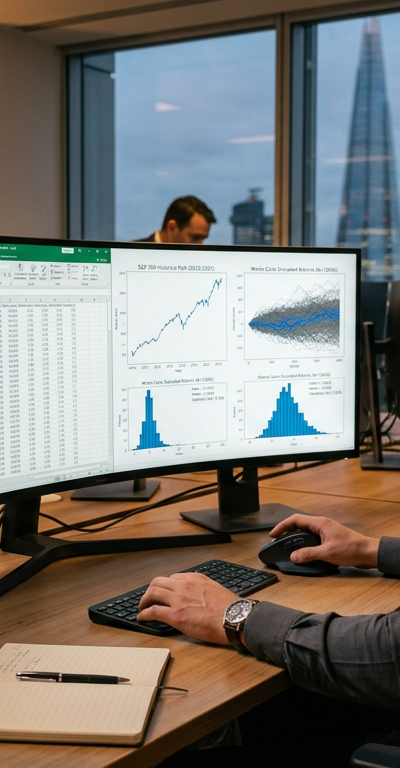
By plotting your trades on a histogram, you can visualize whether your distribution fits your intended strategy. If you are a trend follower but your distribution shows no large winners, your What Is Trade Execution in Trading process may be flawed, perhaps because you are cutting your winners too early. Analyzing whether your distribution is "fat-tailed" or "skewed" helps you identify if you are exposed to unexpected events that could blow up your account.
The Role of Randomness and Variance
Variance is the technical term for the fluctuations within your trade distribution. Even if two traders have the exact same win rate and risk-to-reward ratio, their equity curves will look vastly different because of variance. One trader might experience a smooth upward trajectory, while the other faces gut-wrenching volatility before reaching the same endpoint.
The reality of randomness means that the sequence of your trades is outside of your control. You cannot predict when the wins will come. This is why professional traders focus on the process rather than the outcome. If you have a documented edge, the variance is simply the "cost of doing business."
If you do not account for variance in your projections, you will likely undercapitalize your account and face a margin call during a standard corrective phase of your distribution. Acknowledging randomness also helps in identifying "luck" versus "skill." A trader who makes 50% in a month might just be on the right side of a random cluster in their trade distribution. Without a large enough sample size (typically 100+ trades), it is impossible to determine if the performance is sustainable or merely a statistical anomaly. This is why consistently logging data is non-negotiable for long-term success.
Managing Drawdowns Within the Distribution
A drawdown is a peak-to-trough decline in an account's value during a specific period. In the context of trade distribution, drawdowns are the result of losing trade clusters. Every trader, regardless of how successful they are, will eventually face a drawdown. The difference between those who survive and those who fail is how they manage their risk during these phases.
When you understand your trade distribution, you can calculate the mathematical probability of experiencing a certain number of consecutive losses. For instance, a strategy with a 50% win rate still has a significant statistical chance of experiencing seven or eight losses in a row over a sample of 200 trades. If you are risking 5% of your account per trade, an 8-trade losing streak would result in a 40% drawdown (or more due to compounding). This would be psychologically devastating for most individuals, often leading to total abandonment of the strategy.
By analyzing your distribution, you can adjust your position sizing to ensure that even the "worst-case" cluster of losses does not result in a catastrophic loss of capital. You are essentially "smoothing" the distribution to protect your emotional capital and keep your account in the green over months and years, not just days. To prepare for these inevitable phases, it is highly recommended to use a Drawdown Calculator to simulate how your account would handle a prolonged sequence of losses.
🎸 Start Your Trading Journal
Track, Analyze, and Improve Every Trade You Make
Time-Based Distribution and Seasonality
Trade distribution isn't just about the sequence of wins and losses; it's also about when those trades occur. Many strategies perform differently depending on the market environment, which varies by time of day, day of the week, or even month of the year. This segmentation is crucial for understanding your edge.
For example, a breakout strategy might show a very positive distribution during the London and New York session overlaps when volatility is high, but the same strategy might show a cluster of "fake-out" losses during the late Asian session. If you aggregate all your trades together, the distribution might look mediocre. However, if you segment the distribution by time, you might find that you are a world-class trader for three hours a day and a losing trader for the other twenty-one.
Analyzing time-based distribution allows you to refine your edge. It helps you recognize "regime shifts." If your trade distribution has been consistently positive for six months and suddenly shifts to a negative cluster, it may indicate that the market environment has changed (e.g., shifting from a trending market to a range-bound market). Identifying these shifts early through data analysis allows you to step aside or reduce your risk before the drawdown becomes excessive.
Using Distribution Data to Optimize Strategy
Once you have a large enough sample of trades, you can use the distribution data to optimize your performance. This goes beyond just "filtering" bad trades; it involves understanding the characteristics of your winners versus your losers.
- Analyze the Mode: Look for the most common R-multiple (risk-to-reward ratio). If your distribution shows that 80% of your winning trades reach 2R but only 10% reach 3R, it might be more profitable to consistently exit at 2R.
- Maximum Adverse Excursion (MAE): This measures the furthest a trade went against you before closing. If winners rarely go more than 0.5R into the red, but your stop loss is at 1R, you may be able to tighten your stops.
- Sample Size Verification: Ensure you have at least 100 data points. Smaller samples can be skewed by luck and do not represent a true trade distribution.
A refined understanding of your distribution allows you to move from "hope-based" trading to "evidence-based" trading. You stop looking for the "perfect entry" and start focusing on the "perfect sample."
Mastery of Trade Sequences
One of the most difficult lessons for a developing trader is that the market does not owe you a win just because you had three losses. In a random distribution, each event is independent of the previous one. This is known as avoiding the Gambler's Fallacy. Just because a "win" is statistically due doesn't mean it will happen on the next trade.
Successful professionals treat their trading like a casino treats its floor games. The casino knows that on any given hand of blackjack, the player might win. However, because the casino understands the distribution of outcomes over thousands of hands, they remain calm and profitable. They do not get angry when a player hits a jackpot, nor do they get excited when they take a player's house. They simply manage the distribution.
When you apply this to your own trading, your stress levels will drop significantly. You will find that you no longer need to check the charts every five minutes to see how a trade is doing. You have already accepted that the trade is just one small data point in a very large and predictable distribution.
The Long-Term Perspective
To truly master trade distribution, one must adopt a multi-year perspective. Retail trading attracts many people who are looking for a "quick win" or a way to pay off immediate bills. These individuals are almost always the victims of trade distribution because their time horizon is too short to survive the natural variance of the market.
Professional trading is more akin to insurance underwriting. An insurance company knows they will have to pay out claims (losses). They don't know exactly when those claims will come, but they know that based on their distribution data, they will collect more in premiums than they pay out in claims over the course of a year. Your trading strategy is your premium, and your losing trades are your claims.
By shifting your focus to the annual or quarterly distribution, you give your strategy the space it needs to work. You stop interfering with your trades, you stop skipping signals out of fear, and you stop increasing your size out of greed. This level of professional detachment is only possible when you have full confidence in your statistical distribution.
Advanced Metrics in Distribution Analysis
Beyond simple wins and losses, advanced traders look at "Expectancy Per Trade" and "Standard Deviation of Returns." These metrics provide a deeper look into the stability of your distribution. If your standard deviation is very high, it means your results are erratic and your account is at higher risk. A low standard deviation suggests a more "controlled" distribution that is easier to manage psychologically.
You should also monitor your "Profit Factor," which is the total gross profit divided by the total gross loss. A healthy distribution typically has a profit factor above 1.5. If your profit factor starts to dip toward 1.0, it is a sign that your distribution is becoming inefficient and you may need to re-evaluate your strategy or your execution.
Remember that a distribution is not static. As market conditions evolve, your distribution will evolve with them. What worked in a high-volatility environment may produce a different distribution in a low-volatility environment. Continuous monitoring through a journal is the only way to stay ahead of these changes.
Frequently Asked Questions
What is the difference between win rate and trade distribution?
Win rate is a fixed percentage representing total successes over total attempts. Trade distribution is the chronological order and grouping of those results. Two traders can have a 50% win rate, but one might have an alternating win-loss pattern, while the other faces ten wins followed by ten losses. The distribution determines the emotional and financial difficulty of a strategy.
How many trades do I need to see a reliable distribution?
A reliable distribution typically requires a minimum of 100 trades. Statistical significance is difficult to achieve with smaller samples because randomness can easily disguise an edge or create a false sense of security. Once you reach 100 trades, the law of large numbers begins to take effect, providing a more accurate representation of your strategy’s long-term performance.
Can trade distribution help me avoid revenge trading?
Yes, understanding distribution is one of the best ways to stop revenge trading. When you accept that a cluster of losses is a mathematical certainty rather than a personal failure, you lose the "need" to win back money immediately. You recognize that the next trade is simply the next data point in a sequence, not a tool for emotional validation.
Why does my distribution look different in a demo account?
Distributions often differ between demo and live trading due to the psychological pressure of real capital. In a demo account, traders are more likely to follow their rules perfectly, leading to a "clean" distribution. In live trading, fear and greed often lead to poor execution, which skews the distribution negatively. Comparing the two can help identify your psychological weaknesses.
Does trade distribution change with different timeframes?
While the concept remains the same, the frequency of trades changes. A scalp trader might complete a 100-trade distribution in a week, while a swing trader might take six months. The scalp trader faces higher variance in a shorter period, whereas the swing trader must maintain psychological discipline over a much longer duration to see their distribution play out.
Related reading: What Is Trade Distribution in Trading.
Related reading: What Is Trade Execution in Trading.
Conclusion
Mastering trade distribution is the ultimate evolution for any trader. It moves the focus from "being right" to "being profitable." By understanding that individual trades are irrelevant and only the sequence matters, you can build a sustainable trading career based on data, logic, and professional risk management. Start tracking your distribution today, embrace the variance, and let the law of large numbers work in your favor.
Related Resources
Everything You Need to Trade Smarter — Start Today
Ready to level up your trading?
Track, analyze, and improve your trades with RockstarTrader's trading journal.
Start Free Trial